The Prussia Market Development - Presented By The
LET MISTER SCREEN ASSIST YOU
GLOBAL INDEXThe Urban Cartographer
TECHNICAL STUFFDiscover the history of Blackhorse Avenue, Dublin 7. From the medieval 'Blackhorse Inn' to the architectural splendour of McKee Barracks and the 1875 stone bridge over the railway cutting, explore this unique road on the edge of Phoenix Park. Read about its military connections, local landmarks, and current redevelopment trends.
EXCELLENT PICTURE THIS 2017
The Prussia Market Development - Presented By The
The Prussia Market Development
Author:
|
13. Jan 2026
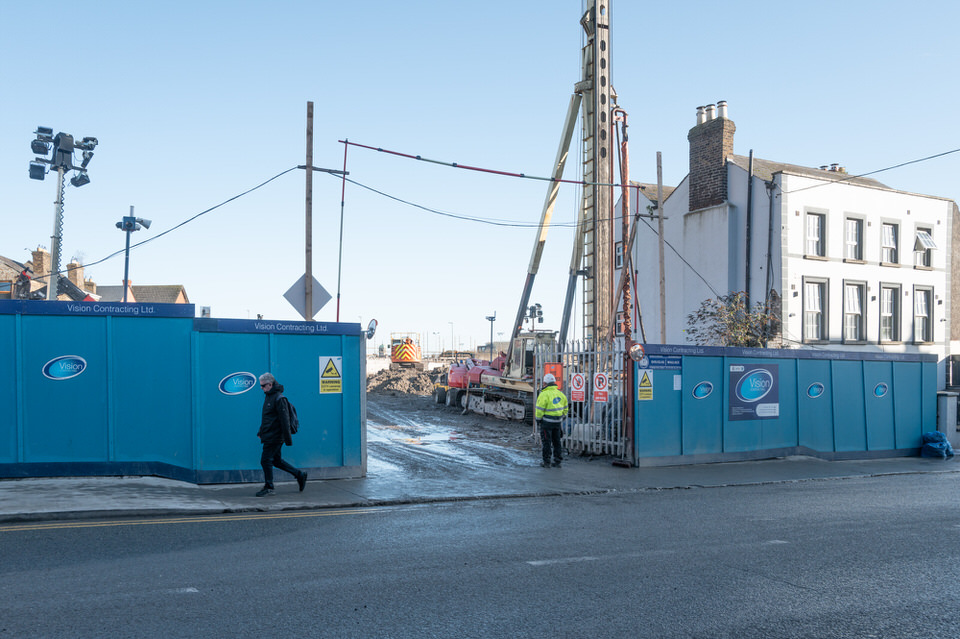
Photographed By William Murphy I consider myself fairly tuned into the rhythms of Dublin 7. Living just on the other side of the TU Dublin Grangegorman campus, near Henrietta Street, Stoneybatter isn't just a neighbouring district; it's part of my regular orbit. For a long time, when neighbours expressed fears about the area being "dominated" by the expanding university campus, I was inclined to dismiss them. I saw the regeneration as a positive force, bringing life to old industrial sites. But walking down Prussia Street this week, I got a genuine jolt of surprise—and for the first time, I began to share those doubts. The Shock of Prussia Market I stopped dead in my tracks at numbers 23-28. The hoarding was up, the cranes were towering, and a vast construction site branded as "Prussia Market" was underway. This isn't a small infill project; it is a massive, multi-block development that seemed to have sprung up overnight. The scale is what rattled me. The development effectively swallows St. Joseph's Place, a cul-de-sac defined by solid, two-storey homes. The new blocks wrap around these houses, dwarfing them and creating a canyon effect that visually screams "density." The Belfast Parallel: A Ghost Town in Summer? My sudden change of heart isn't just about this one building site; it’s about what it represents when I compare it to my time photographing the Queen's Quarter in Belfast. For years, I have documented that area, and I have seen firsthand the negative impact a university can have when it completely dominates a residential neighbourhood. In Belfast, the "studentification" of the area around Queen's University has created a strange, dual existence. For four months of the year, outside of term time, the area becomes effectively derelict. Buildings sit empty, the streets are quiet, and the local economy dips. Conversely, during term time—and famously around St. Patrick's Day—the area suffers from massive anti-social behaviour that has driven out many long-term residents. The Numbers Don't Lie I used to think Stoneybatter was immune to this because "it's not that big." But looking at the numbers, the parallel is closer than I realised. Queen’s University Belfast has a student population of over 25,000. While TU Dublin as a whole is larger (around 28,000–30,000 students across all campuses), the specific Grangegorman campus is currently smaller than Queen's. However, that is rapidly changing. The master plan for Grangegorman is to consolidate the scattered colleges onto this one site, eventually accommodating over 20,000 staff and students. We are moving towards a scenario where the student population in our immediate vicinity will rival the size of Queen's University Belfast. A Tipping Point? When I look at the cranes over St. Joseph’s Place, I’m no longer just seeing "homes." I’m seeing the infrastructure for a demographic shift that could replicate the Belfast experience. We have already absorbed a massive influx of Purpose-Built Student Accommodation (PBSA). Now, we are seeing high-density private rentals like Prussia Market. The fear is that Stoneybatter and Manor Street, famous for their year-round "village feel," could tip into becoming a seasonal dormitory—overrun in March, ghost-town quiet in July. I used to think the "dominance" of the campus was an exaggeration. Standing under the shadow of the new tower on Prussia Street, looking at the numbers, I’m starting to think it might be an inevitability.Select Image To Visit The Photo Gallery: The Prussia Market Development
GALWAY CITY
CORK CITY AND COUNTY
GLOBAL MENU
DUBLIN SOUTHSIDE
DUBLIN NORTHSIDE
URBAN CARTOGRAPHER
EXCELLENT PICTURE THIS 2017
The Prussia Market Development - Presented By The
Who Is Building An Experience Which Is Getting Better Day By Day