The Collegiate Church of St. Mary - Presented By The Urban Cartographer
LET MISTER SCREEN ASSIST YOU
GLOBAL INDEXThe Urban Cartographer
TECHNICAL STUFF
EXCELLENT PICTURE THIS 2017
The Collegiate Church of St. Mary - Presented By The Urban Cartographer
The Collegiate Church of St. Mary
Author: Urban Cartographer
|
26. Nov 2025
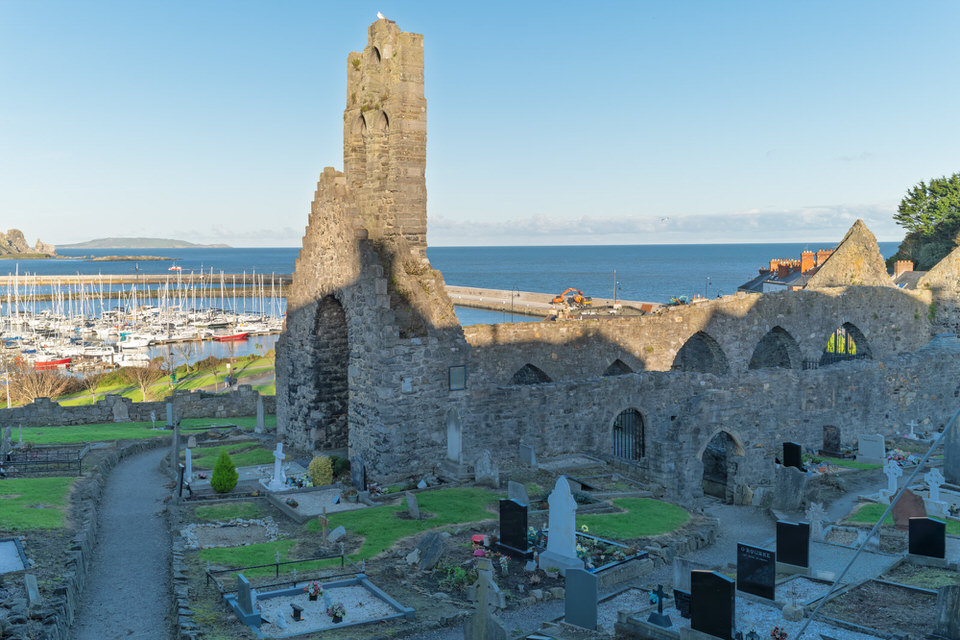
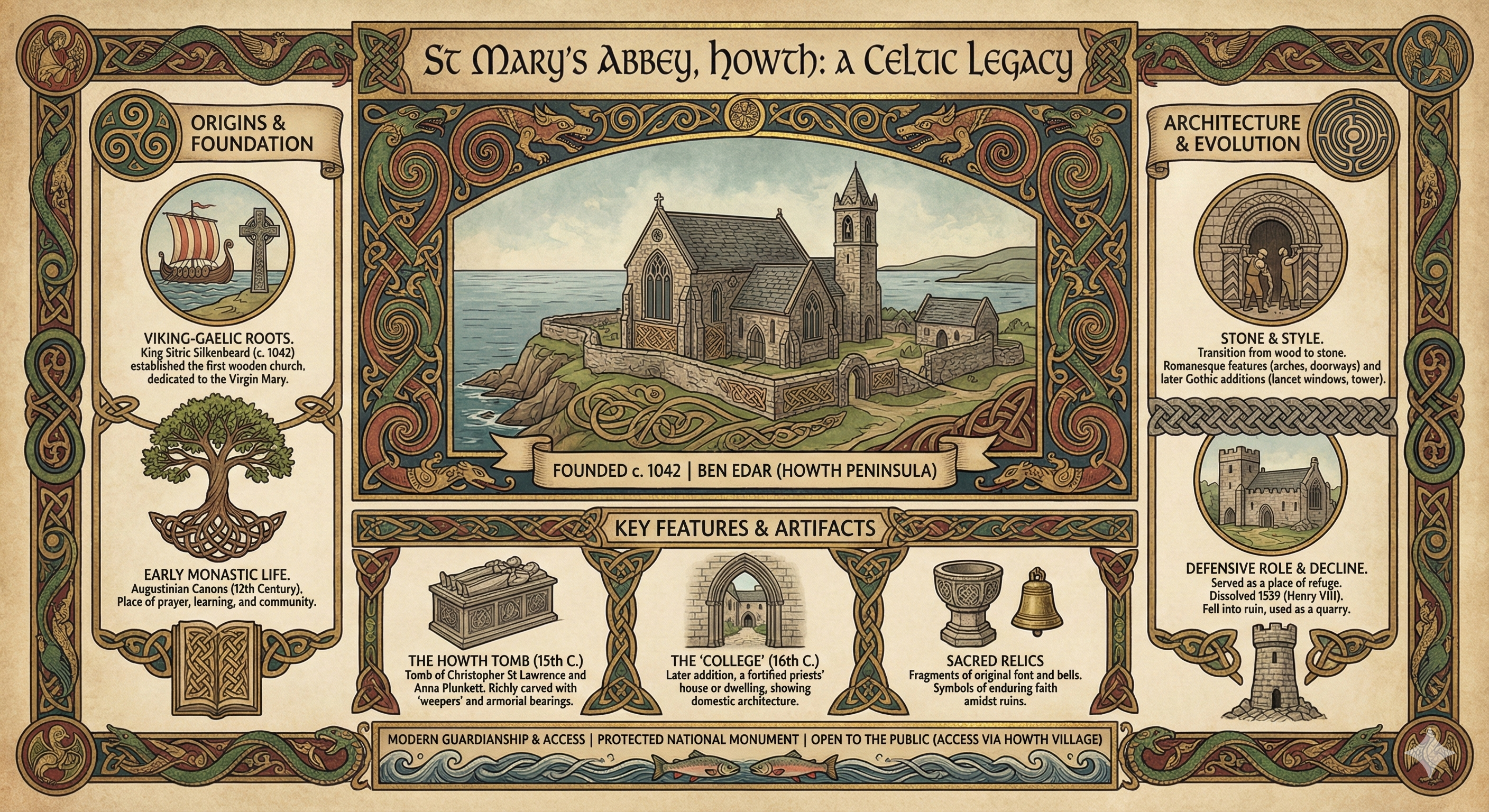
The peninsula of Howth, anciently known as Binn Éadair, occupies a singular position in the physical and cultural geography of the Dublin region. Distinct from the limestone lowlands of the adjacent Fingal plain, Howth is effectively an island connected to the mainland only by the sandy tombolo of the Sutton isthmus. This geological separation has, for millennia, fostered a sense of detachment that is reflected in its ecclesiastical history. The ruins of St. Mary’s Abbey, situated on a terrace overlooking the harbour, are the physical manifestation of a distinct Lordship maintained by the St. Lawrence family for centuries. The site of St. Mary’s is a landscape where successive layers of history—Hiberno-Norse, Anglo-Norman, and modern—overlap. The topography is essential to understanding the site's significance. Rising from the harbour, the church sits on an elevated platform that commands panoramic views of the Irish Sea and the island of Ireland’s Eye. This visual link represents the axis upon which the religious life of the peninsula turned, shifting from the monastic isolation of the island to the collegiate engagement of the town. In the context of your visit on November 25, 2025, the site presents itself as a stabilized ruin, the beneficiary of recent conservation interventions. These works, necessitated by climate-induced weathering and structural failures, have transformed the visitor experience, arresting the decay of the medieval fabric while navigating the sensitivities of a burial ground that remains significant to the local community. It is necessary to address the nomenclature. While locally known as "St. Mary’s Abbey," the site was never an abbey in the strict monastic sense. It was a collegiate church. It was served by a "college" (chapter) of secular priests—clergy who lived in the community rather than in a cloister—under the leadership of a Provost or Warden. This distinction explains the architecture; there is no cloister walk or refectory. Instead, the domestic needs of the clergy were met by the separate "College" building on Abbey Street. The ecclesiastical history of the site predates the Anglo-Norman invasion. The foundation is attributed to Sitric Silkenbeard (Sigtrygg Silkbeard), the Norse King of Dublin, around the year 1042. Sitric’s foundation was a statement of both piety and power. By 1042, the Norse Kingdom of Dublin was integrating into the broader Christian polity of Europe. The location was strategic; a church here served the spiritual needs of the fleet and acted as a navigational landmark. While no physical fabric of this 11th-century church remains visible, the continuity of the site established a locum sanctum (holy place) that persisted through subsequent political upheavals. Before the rise of the mainland church, the spiritual focus was the monastery on Ireland’s Eye. In approximately 1235, the Archbishop of Dublin sanctioned the translation of the prebend from the island to the mainland church. This act, supported by the St. Lawrence family, marked the shift from ascetic isolation to the organized parish system of the medieval colony. The history of St. Mary’s is tied to the St. Lawrence family, who held the title of Baron (and later Earl) of Howth for over 800 years. The St. Lawrences used the church as a theatre of dynastic legitimacy, endowing the fabric and using the chancel as their private burial ground. The collegiate status ensured priests were employed to chant masses for the souls of the ancestors. The family’s ability to navigate Irish history is reflected in the church; they maintained the building long after the Dissolution of the Monasteries, eventually moving their primary worship to the private chapel in Howth Castle around 1630. The ruins visible today are largely the product of a rebuilding campaign in the late 14th and early 15th centuries. The church is a double-aisled structure, consisting of a nave and a large south aisle, separated by an arcade of pointed arches. The south aisle was likely expanded to accommodate the additional altars required by the collegiate priests. In the 15th century, Fingal was subject to raids. The church walls are thick and the parapets were crenellated, giving the church a fortress-like appearance. This allowed the church to serve as a place of refuge for the community during attacks. One of the important elements of the site other than the church ruin is the building known as "The College," located on Abbey Street. Dating from the late 15th or early 16th century, this building served as the communal residence for the priests of the collegiate church. While thousands of medieval churches survive in Ireland, the domestic buildings of the secular clergy have almost entirely vanished, making this a rare exception. The building is essentially a fortified tower house adapted for urban living. It originally contained a communal hall for dining and dormitories for the priests. Like the church, it has thick walls and small windows for defense. It is now a private residence, but its exterior helps visitors visualize the medieval "campus" of Howth. You noted that "many of the graves are in excellent condition while others are not." The graveyard reflects the social stratification of Howth. The most significant artifact is the St. Lawrence Tomb in the chantry chapel. This double-effigy tomb commemorates Sir Christopher St. Lawrence (d. c. 1462) and his wife Anna Plunkett. It is a masterpiece of the "Pale School" of sculpture, depicting Sir Christopher in plate armour and Anna in a horned headdress. Its "excellent condition" is due to the shelter provided by the church walls. The condition of the external graves is partly explained by a catastrophic event. A section of the 18th-century retaining wall collapsed following heavy rains, exposing coffins and destabilizing the ground. The "restoration" you observed likely includes the rebuilding of this wall. Graves nearest the collapse would have been subject to intense remedial work (re-setting headstones), making them appear well-tended, while others show the weathering of centuries. The "much restoration" you observed is driven by specific funding and conservation programs active in 2024 and 2025, largely under the Community Monuments Fund (CMF) and Fingal County Council initiatives. Graveyard Wall Reconstruction Castle Bawn Walls (Howth Castle) Church Masonry Consolidation Grave Markers Fingal County Council’s risk assessments specifically identify St. Mary’s as vulnerable to storm damage and subsidence. The works you witnessed are not just aesthetic improvements but essential adaptations to the changing climate. St. Mary’s Abbey in Howth is a monument of resilience. Founded by Vikings, built by Anglo-Normans, and sustained by the St. Lawrence dynasty, it has survived dissolution and abandonment. The "restoration" I observed on November 25, 2025, represents a significant investment to adapt this medieval structure to the climatic realities of the 21st century, ensuring its survival for future generations.
Select Image To Visit The Photo Gallery: The Old Church In Howth
1. The Peninsula of Binn Éadair: Topography and Ecclesiastical Origins
1.1 The "Abbey" Misnomer
2. The Hiberno-Norse Foundation: King Sitric (1042)
2.1 The Geopolitics of Foundation
2.2 The Island Connection: Ireland's Eye
3. The Anglo-Norman Transformation: The St. Lawrence Dynasty
3.1 The Church as Dynastic Mausoleum
4. The Collegiate Church: Architectural Form and Function
4.1 The Plan
4.2 The "Pale Gothic" Aesthetic
4.3 Defensive Features
5. The "College" of Howth: Domestic Architecture
5.1 A Rare Survival
5.2 Architectural Typology
6. The Necrogeography of St. Mary’s
6.1 The St. Lawrence Tomb
6.2 The Graveyard and Wall Collapse
6.3 Notable Epitaphs
7. Conservation Challenges and the 2024–2025 Restoration
7.1 Restoration Projects Summary (2024-2025)
7.2 Climate Change Adaptation
8. Important Elements Beyond the Church Ruin
9. Conclusion
GALWAY CITY
CORK CITY AND COUNTY
GLOBAL MENU
DUBLIN SOUTHSIDE
DUBLIN NORTHSIDE
URBAN CARTOGRAPHER
EXCELLENT PICTURE THIS 2017
The Collegiate Church of St. Mary - Presented By The Urban Cartographer
Who Is Building An Experience Which Is Getting Better Day By Day