McNally Large Cranes May 2009 - Presented By The Urban Cartographer
LET MISTER SCREEN ASSIST YOU
GLOBAL INDEXThe Urban Cartographer
TECHNICAL STUFFRelive the historic May 2009 installation of Dublin's Samuel Beckett Bridge. Discover the engineering precision required to transport the Calatrava-designed structure from Rotterdam and the vital role played by McNally’s Crane Hire in one of Ireland’s most iconic heavy-lifting projects.
EXCELLENT PICTURE THIS 2017
McNally Large Cranes May 2009 - Presented By The Urban Cartographer
McNally Large Cranes May 2009
Author: Urban Cartographer
|
20. Feb 2026
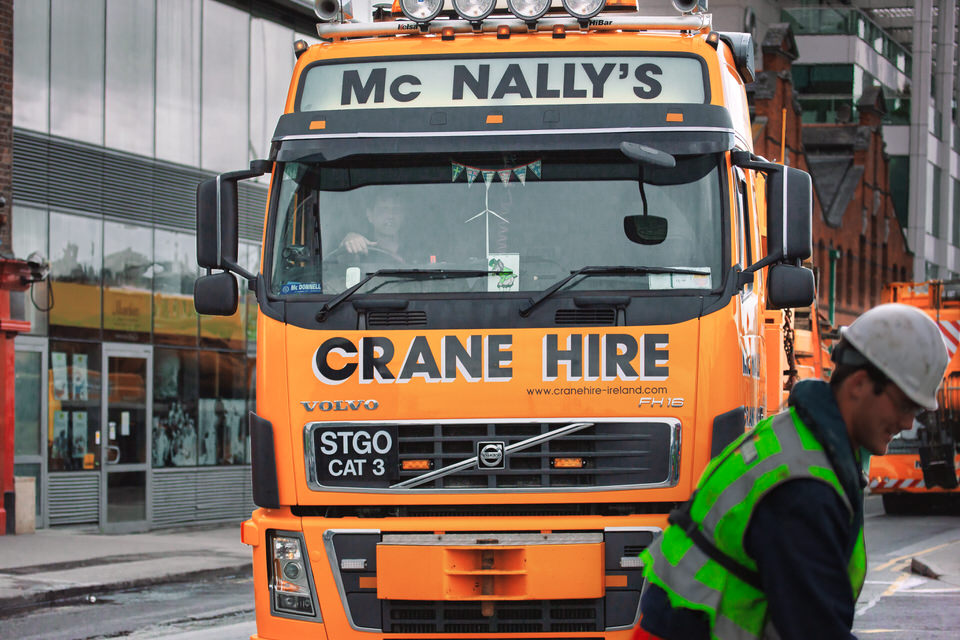
Photographed By William Murphy - Select Image To View Photographs
Select Image Below To Visit The Photo Gallery: McNally Large Cranes May 2009
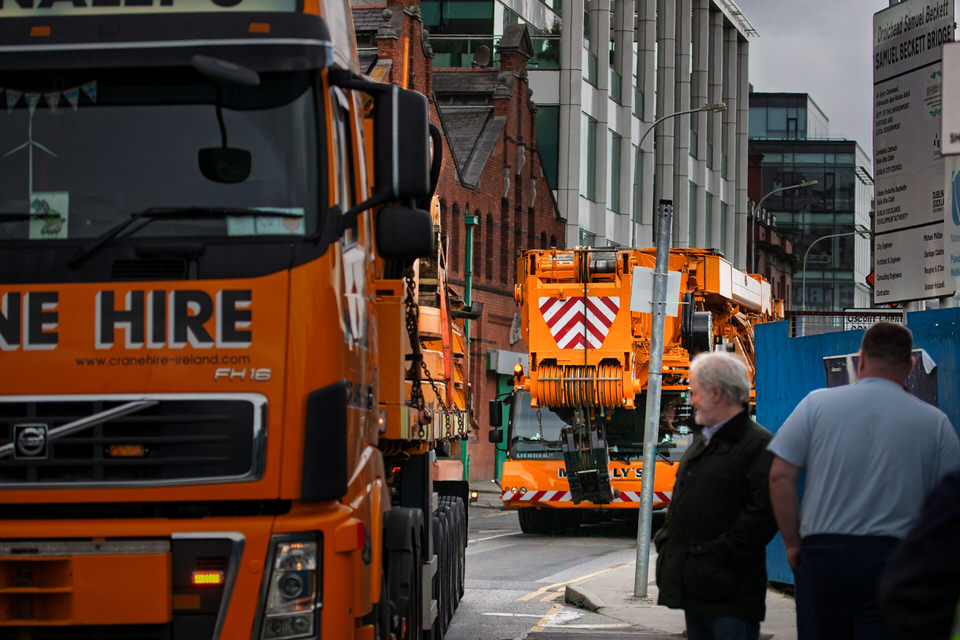
The installation of the Samuel Beckett Bridge in May 2009 was a landmark moment for Dublin’s Docklands. It transformed the Liffey's skyline with Santiago Calatrava’s "harp" design, but the logistics behind moving and placing a 5,700-tonne steel structure were as much a feat of engineering as the design itself.
People were amused by the fact the the crane driver-operator brought his car with him.
The installation of the Samuel Beckett Bridge in May 2009 was a landmark moment for Dublin’s Docklands. It transformed the Liffey's skyline with Santiago Calatrava’s "harp" design, but the logistics behind moving and placing a 5,700-tonne steel structure were as much a feat of engineering as the design itself.
The Installation: May 2009
The bridge superstructure was fabricated by Hollandia in Rotterdam (the same firm behind the London Eye). Its journey to Dublin was a spectacle:
The Sea Voyage: The 123-metre-long structure travelled 628 miles across the North Sea and Irish Sea on a specialist barge, arriving in Dublin in early May 2009.
The Precision Placement: The installation relied on tidal synchronisation. At high tide, the barge was manoeuvred into position over the reinforced concrete river pier. As the tide receded, the bridge was precisely lowered onto its pivot mechanism.
Balancing Act: Once seated, the bridge had to be "tuned" with steel and concrete ballast to ensure it was perfectly balanced for its 90-degree rotational opening mechanism.
McNally’s Crane Hire
McNally’s Crane Hire (now part of the Windhoist Group for its wind energy operations) played a crucial role in the land-based support and heavy lifting throughout the project’s construction phase. Founded in 1958 by Dan McNally, the company built a reputation on high-stakes civil engineering projects, including the Spire of Dublin and the Boyne Bridge.
For the Samuel Beckett project, McNally’s provided the heavy-lifting infrastructure required to assemble the land-side components and support the Graham Hollandia Joint Venture.
The Equipment Used
To manage a structure of this scale, the project utilised a combination of massive floating and land-based plant:
SF08 RMY (The Heavy Lifter)
This is a UK registration (specifically from the Glasgow/Scotland region, where McNally’s Windhoist division operated).
Vehicle Type: This plate belonged to a Liebherr LTM 1500-8.1.
Capacity: 500 tonnes.
Role: This was one of the "stars" of the McNally fleet at the time. In 2009, it was a relatively new addition (registered in 2008). Given its massive 8-axle chassis, it would have been used for the primary land-side lifts, such as positioning the heavy pylon sections or the massive cable anchors before the main bridge span arrived on the barge. It is easily recognisable by its sheer length and the "Windhoist" or "McNally" branding often seen on the boom.
06-D-43644 (The Support Crane)
This is a Republic of Ireland registration from Dublin.
Vehicle Type: This plate belonged to a Liebherr LTM 1100-4.2 (or a similar 100-tonne class 4-axle crane).
Capacity: 100 tonnes.
Role: This was a "service" or "assist" crane. While the 500-tonner did the heavy work, the 100-tonner would have been used for:
Assembling the larger crane (fitting the counterweights).
Lifting smaller structural steel components.
General site logistics and offloading deliveries from transport trucks.
Context of the 2009 Lift
When I photographed these machines, they were part of the Graham Hollandia Joint Venture support team. The Samuel Beckett Bridge was unique because it was "floated in" rather than built in situ.
The 500-tonner (SF08 RMY) would have been stationed on the quayside (likely North Wall Quay) to manage the massive weight of the back-stays.
The 100-tonner (06-D-43644) would have been the "workhorse" moving around the site to ensure everything was ready for the moment the barge, The Pontra Maris, arrived with the main 5,700-tonne structure.
GALWAY CITY
CORK CITY AND COUNTY
GLOBAL MENU
DUBLIN SOUTHSIDE
DUBLIN NORTHSIDE
URBAN CARTOGRAPHER
EXCELLENT PICTURE THIS 2017
McNally Large Cranes May 2009 - Presented By The Urban Cartographer
Who Is Building An Experience Which Is Getting Better Day By Day